
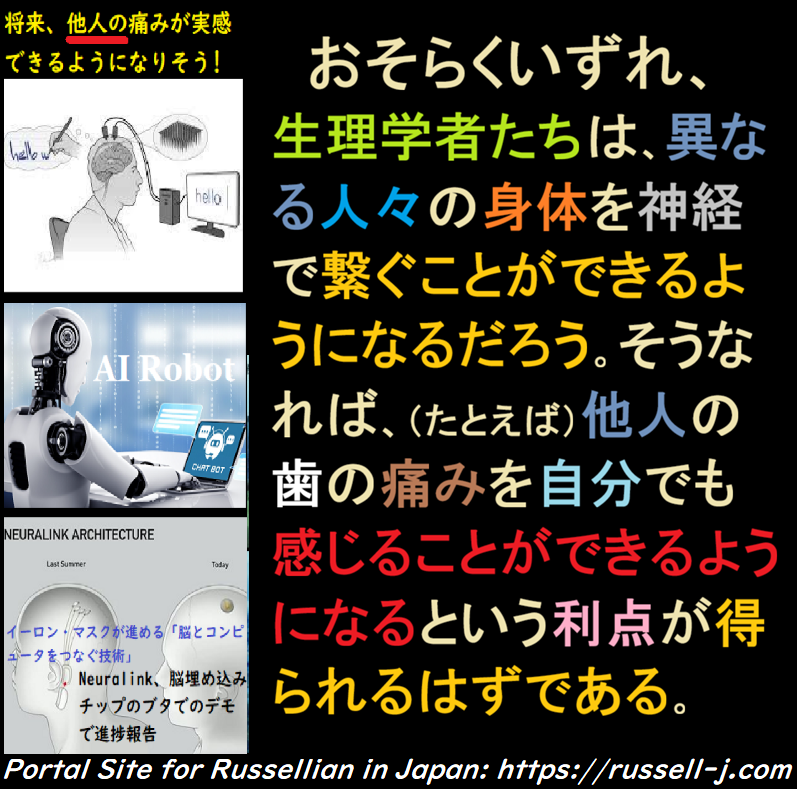
おそらくいずれ、生理学者たちは、異なる人々の身体を神経で繋ぐことができるようになるだろう。そうなれば、(たとえば)他人の歯の痛みを自分でも感じることができるようになる、という利点が得られるはずである。(Probably in time physiologists will be able to make nerves connecting the bodies of different people; this will have the advantage that we shall be able to feel another man's tooth aching.)
Source: Bertrand Russell: An Inquiry into Meaning and Truth ,1940, p.493
他人の痛みと「個体」の境界線
【ラッセルの奇妙な予言】
哲学者バートランド・ラッセルは、1940年の著書『意味と真理に関する探究(An Inquiry into Meaning and Truth)』の中で、非常に示唆に富む一節を記しています。
「おそらくいずれ、生理学者たちは、異なる人々の身体を神経で繋ぐことができるようになるだろう。そうなれば、(たとえば)他人の歯の痛みを自分でも感じることができるようになるという利点が得られるはずである。」ラッセルらしい皮肉のきいた表現ですが、ここで彼が突いているのは「私の経験は私だけのものであり、他人には決して直接伝わらない」という認識論的な壁です。
【欧米の視点:断絶しているからこそ理解しようとする】
欧米、特にラッセルがいたイギリスなどの英語圏では、**「自分の心と他人の心は、物理的に切り離された別個の存在である」**という「個体論」的な前提が非常に強固です。 彼らにとって、他人の心は「ブラックボックス」であり、見えないのが当たり前です。だからこそ、
言葉による論理的な説明
客観的なデータ(痛みのスケールなど)
理性的な想像力(エンパシー)
などを駆使して、その断絶を埋めようとします。「わからない」という絶望的な距離があるからこそ、歩み寄るための倫理が発達してきたとも言えるでしょう。
【日本の視点:「察し」と境界の曖昧さ】
一方で、私たち日本人の感覚では、他人の痛みは「説明されて理解するもの」以上に、**「身につまされるもの」**として捉えられる傾向があります。
「以心伝心」や「察し」という言葉に象徴されるように、日本では自他の境界線が比較的緩やかで、相手の感情に文字通り「同化」することが美徳とされます。そのため、「他人の痛みがわからない」という言葉は、単なる能力不足ではなく、「情がない」「人間失格だ」といった強い道徳的非難として響くことが多いのです。
【結び:神経が繋がった世界】
ラッセルが夢想(あるいは揶揄)したように、もし技術的に神経が繋がって「他人の歯の痛み」が自分に流れ込んできたら、私たちは幸せになれるでしょうか?
境界線が消え、自他の区別がなくなれば、確かに「誤解」はなくなるかもしれません。しかし、同時に「自分という個体」の独立性も失われてしまうでしょう。
「わからない」という距離があるからこそ、私たちは言葉を尽くし、相手を尊重しようと努力できる――ラッセルの言葉を読み返すと、そんな皮肉な「個の尊厳」について考えさせられます。
皆さんは他人の痛みが直接伝わる世界を望みますか?
The Boundary of the "Self": Bertrand Russell and the Pain of Others
Russell's Strange Prediction
The British philosopher Bertrand Russell, in his 1940 work An Inquiry into Meaning and Truth, wrote a deeply provocative passage:
"Probably in time physiologists will be able to make nerves connecting the bodies of different people; this will have the advantage that we shall be able to feel (for example) another man's tooth aching."While Russell’s tone is characteristically dry and witty, he is pointing toward a profound epistemological barrier: the fact that my experiences are mine alone, and can never be directly transmitted to another person.
The Western Perspective: Understanding through Disconnection
In the West, particularly in the English-speaking world, there is a strong "individualistic" premise: the mind of one person and the mind of another are physically and existentially separate.
To them, the mind of another is essentially a "black box." Because this disconnection is taken as a given, people bridge the gap through:
Logical verbal explanations
Objective data (e.g., pain scales)
Rational imagination (Empathy)
Because there is an inherent distance that feels "unknowable," a specific ethic of trying to step into another’s shoes (the "Golden Rule") has flourished.
The Japanese Perspective: The Ambiguity of Boundaries
In contrast, in Japanese culture, the pain of others is often felt as something that should be "sensed intuitively" (sashi) rather than explained.
Concepts like ishin-denshin (telepathy/heart-to-heart communication) suggest that the boundaries between self and other are more fluid. In Japan, being told "you don't understand the pain of others" carries a heavy moral weight, implying a lack of humanity or "warmth," rather than a mere lack of communication skill.
Conclusion: A World of Connected Nerves
If, as Russell imagined, technology allowed our nerves to be physically linked and the pain of another’s toothache flowed directly into us, would we truly be happier?
If the boundaries vanished and the distinction between "self" and "other" disappeared, misunderstandings might vanish, but so too would our individual independence. Perhaps it is only because of this distance -- this "unknowing" -- that we are forced to use language and make a conscious effort to respect one another.
Would you truly want to live in a world where the pain of others is felt directly as your own?
 ラッセル関係電子書籍一覧 |
 ラッセル関係電子書籍一覧
#バートランド・ラッセル #Bertrand_Russell