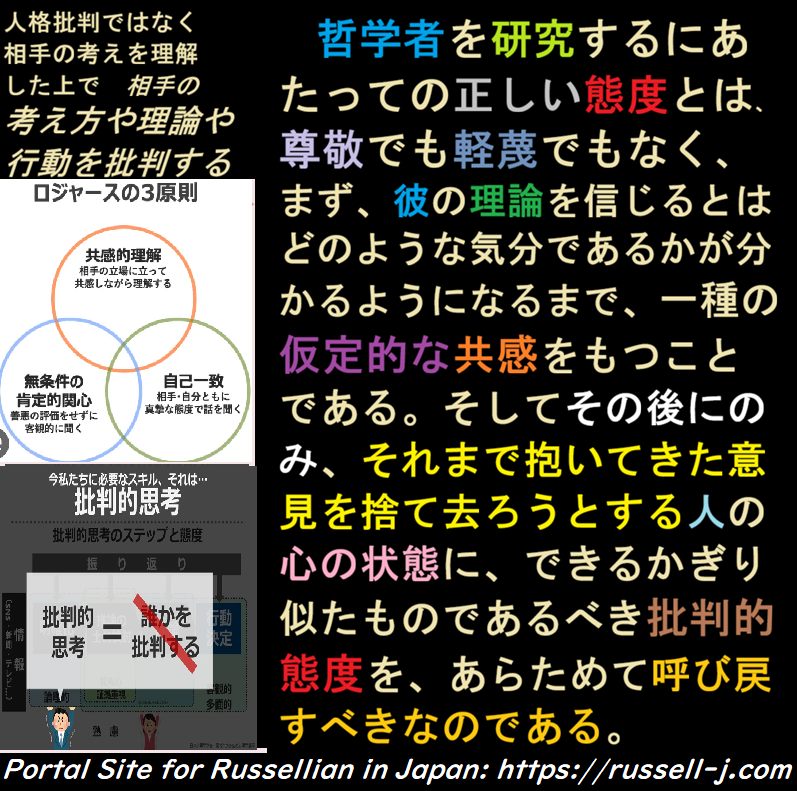
哲学者を研究するにあたっての正しい態度とは、尊敬でも軽蔑でもなく、まず、彼の理論を信じるとはどのような気分であるかが分かるようになるまで、一種の仮定的な共感をもつことである。そしてその後にのみ、それまで抱いてきた意見を捨て去ろうとする人の心の状態に、できるかぎり似たものであるべき批判的態度を、あらためて呼び戻すべきなのである。
In studying a philosopher, the right attitude is neither reverence nor contempt, but first a kind of hypothetical sympathy, until it is possible to know what it feels like to believe in his theories, and only a revival of the critical attitude, which should resemble, as far as possible, the state of mind of a person abandoning opinions which he has hitherto held.
Source: A History of Western Philosophy, 1945.
<寸言>
「ラッセル-折々の言葉」(Bertrand Russell Quotes - occasional edition)の今年最後の投稿です。年末年始(12月29日から1月4日)はお休みします。来年(2026年)は1月5日(月曜日)から再開する予定です。
ラッセル『西洋哲学史』を読む態度について
他人の考えや気持ちを理解することは、非常に難しいことです。しかしそのことは多くの人が暗黙のうちに理解しており、実際には、それほど深くお互いを理解していなくても社会はそこそこ機能しています。それほど深い思想などをもたない一般市民同士でさえ、相互理解は容易ではありません。ましてや、世界を代表する哲学者の思想を全体として理解することなど、ほぼ不可能だと言ってよいでしょう。
ところが、そうした哲学者の著作の中に、自分が共感できることがいくつも書かれていると、それだけでその哲学者を理解したような気になってしまいがちです。特に若い人には、その傾向が強いように思われます。
それでもラッセルは、そうした困難を十分に承知したうえで、「哲学者を研究するにあたっての正しい態度」について、次のようなアドバイスを与えています。
「哲学者を研究するにあたっての正しい態度とは、尊敬でも軽蔑でもなく、まず、彼の理論を信じるとはどのような気分であるかが分かるようになるまで、一種の仮定的な共感をもつことである。そしてその後にのみ、それまで抱いてきた意見を捨て去ろうとする人の心の状態に、できるかぎり似たものであるべき批判的態度を、あらためて呼び戻すべきなのである。」まさに「言うは易くして行い難い」態度です。しかしラッセルは、それを実際に自ら実践したからこそ、名著『西洋哲学史』(A History of Western Philosophy, 1945)において、多くの過去の哲学者たちについて、深い理解と的確な批判を示すことができました。そしてその内容を、読者に理解させ、さらには共感をもたせることにも成功したのだと思います。
(In studying a philosopher, the right attitude is neither reverence nor contempt, but first a kind of hypothetical sympathy, until it is possible to know what it feels like to believe in his theories, and only a revival of the critical attitude, which should resemble, as far as possible, the state of mind of a person abandoning opinions which he has hitherto held.)
アインシュタインも、ラッセルの『西洋哲学史』を次のように激賞しています。
「バートランド・ラッセルの『西洋哲学史』は貴重な書物である。この偉大な思想家ラッセルにおけるすばらしい新鮮さと独創性、換言すれば、過去の遠い時代や異質的な精神にたいする感情移入の鋭さについて、私はいかにそれを頌えるべきか、言葉を知らないくらいである。現代――この、かくもドライで野蛮な時代においてすら、かくも英知にみち、信頼に値し、徹底的であり、しかもヒューマーにみちあふれた人間が存在することを示し得るのは、幸福である。この本は党派や見解のもろもろの闘争をはるかに超越し、もっとも深い意味で教育的である。」『西洋哲学史』はもともと、バーンズ美術館の創設者として知られるバーンズ博士の求めに応じ、バーンズ財団の市民公開講座用に執筆されたものです。そのため、一般市民にも理解できるような書き方が意識されており、また、あえて極端な表現を用いて、聴講者(読者)を喜ばせようとしている箇所も少なくありません。
"Bertrand Russell's 'History of Philosophy' is a precious book. I don't know whether one should more admire the delightful freshness and originality or the sensitivity of the sympathy with distant times and remote mentalities on the part of this great thinker. I regard it as fortunate that our so dry and also brutal generation can point to such a wise, honourable, bold and at the same time humorous man. It is a work that is in the highest degree pedagogical which stands above the conflicts of parties and opinions."
人によっては、そうした点を好ましく思わず、「思想の深さがない」と反発した評論家もいました。その一人が、平凡社『世界大百科事典』の編集長として知られる林達夫です。しかし、ラッセルが意図的に選び取ったこの語り口こそが、哲学史を単なる学説の羅列ではなく、生きた思索の歴史として読者に伝えることを可能にしたのではないでしょうか。
Understanding the thoughts and feelings of others is an extremely difficult task. Most people are implicitly aware of this, and in practice society functions reasonably well even when mutual understanding remains shallow. If even ordinary citizens, who do not hold particularly profound ideas, find it hard to understand one another, then it is fair to say that understanding the thought of a philosopher of world stature as a whole is almost impossible.
Nevertheless, when we encounter passages in a philosopher's writings with which we strongly sympathize, we are easily tempted to believe that we have thereby understood the philosopher himself. This tendency seems especially common among younger readers.
Even so, Bertrand Russell, fully aware of these difficulties, offers the following advice concerning what he calls "the right attitude in studying a philosopher":
In studying a philosopher, the right attitude is neither reverence nor contempt, but first a kind of hypothetical sympathy, until it is possible to know what it feels like to believe in his theories, and only then a revival of the critical attitude, which should resemble, as far as possible, the state of mind of a person abandoning opinions which he has hitherto held.This is truly an attitude that is "easier said than done." Yet it was precisely because Russell himself practiced this attitude that, in his great work A History of Western Philosophy (1945), he was able to demonstrate both a deep understanding of many philosophers of the past and a keen critical judgment of their ideas. More than that, he succeeded in enabling his readers to understand those philosophers and even to feel a degree of sympathy with them.
Albert Einstein, too, spoke in the highest terms of praise for Russell's A History of Western Philosophy, emphasizing Russell's freshness, originality, and remarkable capacity for imaginative sympathy with distant ages and alien modes of thought, and regarding the book as an outstandingly educational work that rises above partisan conflicts of opinions.
A History of Western Philosophy was originally written at the request of Dr. Albert C. Barnes, the founder of the Barnes Foundation, for a series of public lectures intended for general audiences. Accordingly, the book is written in a style accessible to ordinary readers, and in many places Russell deliberately adopts extreme or provocative formulations in order to engage and delight his listeners and readers.
Some critics have disliked this aspect of the book and have objected that it lacks philosophical depth. One such critic was Tatsuo Hayashi, well known as the editor-in-chief of Heibonsha's Encyclopedia of World Knowledge. Yet it may well be argued that this very manner of presentation, consciously chosen by Russell, is what made it possible for him to present the history of philosophy not as a mere catalogue of doctrines, but as a living history of human thought.
 ラッセル関係電子書籍一覧 |
 ラッセル関係電子書籍一覧
#バートランド・ラッセル #Bertrand_Russell