
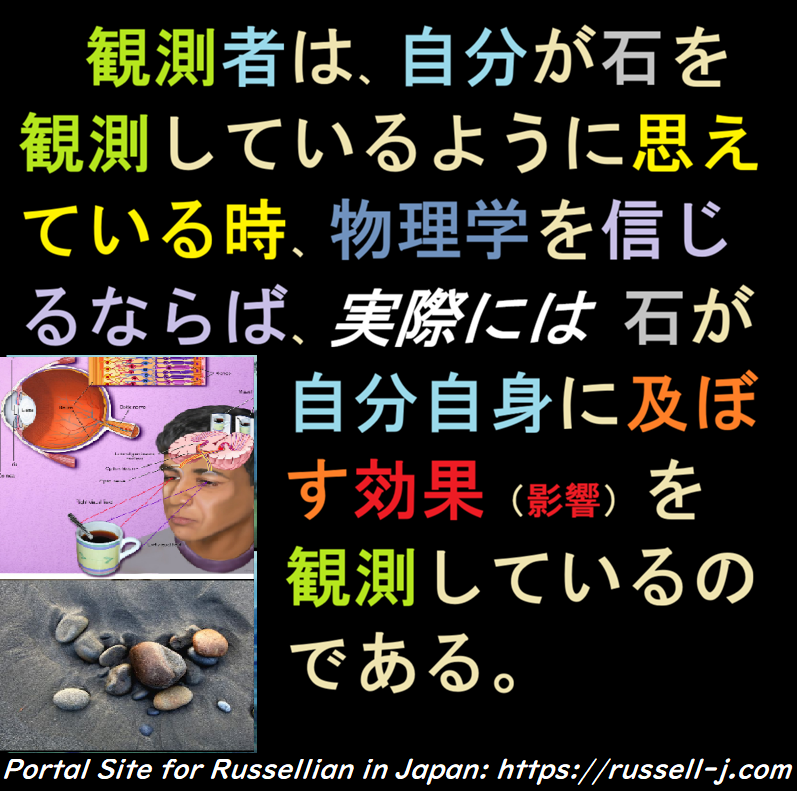
観測者は、自分が石を観測しているように思えている時、物理学を信じるならば、実際には石が自分自身に及ぼす効果(影響)を観測しているのである。。(The observer, when he seems to himself to be observing a stone, is really, if physics is to be believed, observing the effects of the stone upon himself.)
Source: Bertrand Russell: An Inquiry into Meaning and Truth ,1940, Introduction, p. 15
<ラッセルの石と「見る」ことの不確かさ ― 相互理解はなぜ困難なのか>
1. 相手の言っていることを正確に理解するということ
人間の感覚器官の機能は、正常であれば、ほとんど皆同じと言ってよさそうです。しかし、同じ物を見ても、同じ情報を得ても、人によって受け取り方は異なります。 したがって、相手の言っていることを正確に理解することが非常に重要な局面においては、私たちは相手の言っていることの意味やニュアンスを理解しようと努力します。しかし、個人的に知らない政治家(たとえば、トランプや高市早苗)などの発言は、表面的な理解に留まる場合が多いと言えます。しゃべっている本人たちも自分の言うことはシンプルであり、素直に聞けば理解できるはずだと思っていますから、相互理解がいかに困難かわかります。
2. 私たちは本当に「石」を見ているのか?
科学的な観測においても同様の困難があります。バートランド・ラッセルは、『意味と真理の探究』(An Inquiry into Meaning and Truth, 1940)の序論において、次のような指摘をしています。
「観測者は、自分が石を観測しているように思えている時、物理学を信じるならば、実際には石が自分自身に及ぼす効果(影響)を観測しているのである。」 (The observer, when he seems to himself to be observing a stone, is really, if physics is to be believed, observing the effects of the stone upon himself. Source: Bertrand Russell: An Inquiry into Meaning and Truth, 1940, Introduction, p. 15)常識的な事実を言っているだけと思うかもしれません。通常の生活では、対象を「直接」見ていると考えても支障はありません。しかし、多くの場合、私たちは「私たちは自分自身の神経系に生じた現象を観測しているに過ぎない」という事実を忘れています。政治家とのやり取りも同じです。彼らの言葉が直接自分に届いているのではなく、あくまで自分の脳内を通した「解釈」として受け取っているに過ぎません。そのことを自覚するだけで、相手への理解の仕方は変わるはずです。
3. 「人間中心」という認識の檻
できるだけ、我々が外部世界を観察している時に見ているものは、外界からの刺激が視神経を通って脳に達し、それによって自分の脳内に起こった出来事(脳内現象)の「影響」であると反省してみる必要があります。そうすれば、誤解したり騙されたりすることはずっと減るはずです。 人間社会は、人間の平均的な感覚能力をもとにデザインされていますが、そのなかで、たとえば、嗅覚が犬並みだったり、視力が鷹並(あるいはトンボ並)だったりする人がいれば、生きづらいことになりそうです。往々にして、この世界は人間の感覚器官にちょうど都合のよいように出来上がっていると勘違いしがちです。神様さえも、人間に都合のよい神様になっています。私たちが「見ている世界」は、あくまで人間という種の感覚が作り上げた世界観であることを、時折思い出す必要があるでしょう。
Russell's Stone and the Uncertainty of "Seeing": Why Is Mutual Understanding So Difficult?
1. Understanding What Others Are Saying
The functions of human sense organs are, under normal conditions, more or less the same for everyone. However, even when observing the same objects or receiving the same information, people perceive and interpret them differently.
Therefore, in situations where accurately understanding what someone else is saying is crucial, we strive to grasp the meaning and nuances of their words. Yet, when it comes to politicians we do not know personally (for example, Donald Trump or Sanae Takaichi), our understanding often remains superficial. The speakers themselves tend to believe that their own words are simple and should be easily understood if listened to in good faith, which illustrates just how difficult true mutual understanding can be.
2. Are We Really Seeing the "Stone"?
Scientific observation faces similar difficulties. In the Introduction to An Inquiry into Meaning and Truth (1940), Bertrand Russell points out the following:
"The observer, when he seems to himself to be observing a stone, is really, if physics is to be believed, observing the effects of the stone upon himself." (Source: Bertrand Russell: An Inquiry into Meaning and Truth, 1940, Introduction, p. 15)One might think this is merely stating a common-sense fact. In everyday life, it is generally harmless to assume that we are "directly" observing external objects. However, we often forget that we are, in fact, observing only the phenomena generated within our own nervous systems. The same applies to our interactions with politicians. Their words do not reach us directly; we are merely perceiving an "interpretation" created within our own brains. Simply becoming aware of this fact can change the way we understand others.
3. The Cage of "Human-Centric" Perception
We should, as much as possible, try to reflect on the fact that what we see when observing the external world is not the event itself, but the "effects" (the consequences and impacts) of the stimuli reaching our brains via our optic nerves and causing neural phenomena. If we can maintain this perspective, we should be far less likely to be misled or deceived.
Human society is designed based on average human sensory capabilities. Within this framework, individuals with, say, a sense of smell like a dog’s or vision like a hawk’s (or a dragonfly’s) might find it difficult to navigate. We are prone to the misconception that this world is conveniently constructed to suit our human sense organs. Even "God" is often imagined in a way that is convenient for humans. We must occasionally remind ourselves that the world we "see" is merely a worldview constructed by the human species and its specific sensory apparatus.
 ラッセル関係電子書籍一覧 |
 ラッセル関係電子書籍一覧
#バートランド・ラッセル #Bertrand_Russell