
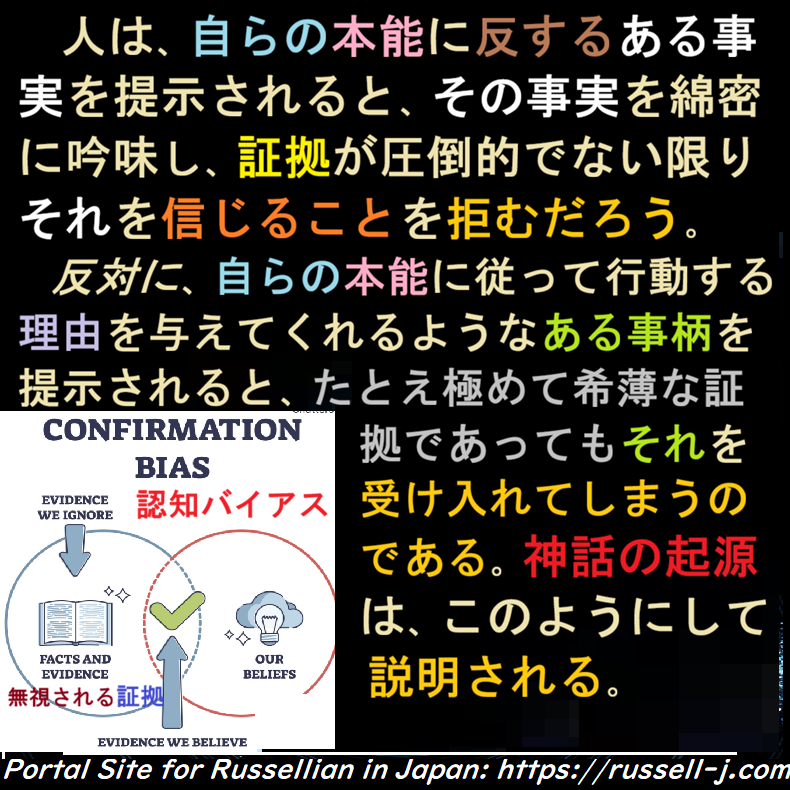
人は、自らの本能に反するある事実を提示されると、その事実を綿密に吟味し、証拠が圧倒的でない限り、それを信じることを拒むだろう。反対に、自らの本能に従って行動する理由を与えてくれるようなある事柄を提示されると、たとえ極めて希薄な証拠であっても、それを受け入れてしまうのである。神話の起源は、このようにして説明される。(If a man is offered a fact which goes against his instincts, he will scrutinize it closely, and unless the evidence is overwhelming, he will refuse to believe it. If, on the other hand, he is offered something which affords a reason for acting in accordance with his instincts, he will accept it even on the slenderest evidence. The origin of myths is explained in this way.)
Source: Bertrand Russell : Mysticism and Logic and Other Essays, 1918, chapter 6: On the Scientific Method in Philosophy
<「認知バイアス」の根源を100年前に見抜いた哲学者>
人間には、「疑い深さ」と「軽信性」という、正反対の性質が同居しています。物事はあるがままに見るべきですが、「言うは易く行うは難し」です。
昨今、メディアで「認知バイアス」や「確証バイアス」という言葉をよく耳にします。現代的な概念に思えますが、実はバートランド・ラッセルは1918年の時点で、そのメカニズムを次のように完璧に言語化していました。
「人は、自らの本能に反するある事実を提示されると、その事実を綿密に吟味し、証拠が圧倒的でない限り、それを信じることを拒むだろう。反対に、自らの本能に従って行動する理由を与えてくれるようなある事柄を提示されると、たとえ極めて希薄な証拠であっても、それを受け入れてしまうのである。神話の起源は、このようにして説明される。(If a man is offered a fact which goes against his instincts, he will scrutinize it closely, and unless the evidence is overwhelming, he will refuse to believe it. If, on the other hand, he is offered something which affords a reason for acting in accordance with his instincts, he will accept it even on the slenderest evidence. The origin of myths is explained in this way.) -- Source: Mysticism and Logic and Other Essays, 1918, chapter 6: On the Scientific Method in Philosophy 」ラッセルが指摘するように、私たちは自分の本能や願望にそぐわない事実は徹底的に疑い、逆に自分を正当化してくれる材料には、驚くほど脆い根拠でも飛びついてしまいます。
世の中には、物語や情緒を好む人々と、それを嫌う人々がいます。しかし厄介なのは、そうした人間の「信じたい」という性質を、政治やビジネスに利用する人々(Bのカテゴリー)の存在です。
現代の政治指導者たちの言動を振り返る際、彼ら自身にどのようなバイアスがあるのか、あるいは彼らが私たちのどのようなバイアスを利用しようとしているのか。それをラッセルの言う「科学的方法」のような冷静さで分析してみることは、混迷する現代において極めて意義深いことではないでしょうか。
The Philosopher Who Foresaw the Roots of "Cognitive Bias" a Century Ago
In every human being, two opposing traits coexist: skepticism and credulity. While we ought to see things as they truly are, it is always "easier said than done."
Nowadays, terms like "cognitive bias" or "confirmation bias" are frequently heard in the media. While these may seem like modern concepts, Bertrand Russell had already articulated their underlying mechanism perfectly as early as 1918:
"If a man is offered a fact which goes against his instincts, he will scrutinize it closely, and unless the evidence is overwhelming, he will refuse to believe it. If, on the other hand, he is offered something which affords a reason for acting in accordance with his instincts, he will accept it even on the slenderest evidence. The origin of myths is explained in this way." (Source: Mysticism and Logic and Other Essays, 1918, Chapter 6: On the Scientific Method in Philosophy)As Russell points out, we tend to thoroughly doubt any facts that do not align with our instincts or desires. Conversely, we leap at any material that justifies our own views, even when the supporting evidence is incredibly fragile.
In this world, there are those who embrace myths and emotions, and those who treat them with distaste. However, the real trouble lies in the existence of people (the "Category B" individuals) who exploit this human tendency to "want to believe" for the sake of politics or business.
When we reflect on the words and actions of today’s political leaders, it would be profoundly meaningful to analyze?with the kind of "scientific method" and detachment advocated by Russell?what biases they themselves hold, and what biases of ours they are attempting to exploit in these turbulent times.
 ラッセル関係電子書籍一覧 |
 ラッセル関係電子書籍一覧
#バートランド・ラッセル #Bertrand_Russell